Flipping the Drift: Behavioural Design for Youth Health in Singapore
A human-centred design project to understand why healthy habits decline among Singapore youth aged 13–16 — and to co-design interventions that work within their real lives.
Two pilot-ready concepts for the agency's national youth wellness programme — embedded in Healthy 365 and Parent for Wellness — with a Pilot Readiness framework, a 7–8 month roadmap to national scale, a proposed integrated validation study, and 26 underexplored areas mapped for the next wave of work.
Delivered end-to-end in 13 weeks across four phases and four gate reviews.
Why do healthy habits decline between ages 13 and 16?
The agency tracks youth health across 6 "Wells" — Eat, Sleep, Exercise, Learn, Bond, and Screen Time. The data showed a consistent decline as youth moved through secondary school, but the data showed what was declining — not why. The answer had to be usable at national scale through the agency's existing channels, and robust enough to hold up under four gate reviews.
I led the engagement end-to-end — planned the 4-phase arc, designed the research, ran the analysis, shaped the final recommendation to the agency, and built the Pilot Readiness framework the agency's team can reuse on future concepts.
- Planned and conducted 26 in-depth interviews (12 youth, 12 parents, 2 experts) — designed the discussion guides, recruited participants, and ran all sessions
- Authored the mental models the team reasoned with — the Drift, the Two Windows, the 2×2, the KAB mapping, and the transition model. These became the shared language we used to evaluate ideas, defend decisions, and align with the agency.
- Facilitated co-creation workshops with 6 youth and 6 parents — designed the scenario prompts, ran ideation, and synthesised 25+ ideas into concept directions through a four-filter triage
- Designed and simulated 3 prototypes and ran validation testing with 24 participants using think-aloud protocol and Likert ratings — then led the convergence into 2 ecosystem-native concepts for the final report
- Built the DVF Pilot Readiness framework — sourced 15 criteria from the agency's pilot governance constraints, categorised across desirability, viability, and feasibility, and calibrated thresholds with the PM
- Ran 4 gate reviews as decision milestones — structured each gate around the minimum evidence needed for the agency to commit, not the maximum I could present
The through-line of this project: building the frameworks that turn research into pilot-ready commitments — and knowing when to converge.
Research
In-depth interviews, affinity mapping, COM-B behavioural analysis, thematic coding, triangulation across youth/parent/expert data, TTM readiness staging
Synthesis
Behavioural ecosystem mapping, 2×2 matrix design, transition zone modelling, opportunity area derivation, HMW iteration
Design
Scenario-based co-creation, DVF scoring, physical prototyping, think-aloud testing, Likert ratings, B=MAP / EAST / Kano assessment
Stakeholder management
4-gate review structure with decision-ready artefacts, progressive disclosure of findings, feedback loops built into each phase transition
Team alignment
Built shared frameworks (the drift, the 2×2, the windows) that gave the team a common vocabulary for evaluating ideas and explaining decisions
Project structuring
Designed the 4-phase structure so each phase answered a specific question before the next one started — no phase ran on assumptions from the one before
From research to pilot-ready concepts
Each phase built on the last. Nothing was invented — every decision traced back to something we heard in research or co-creation. Phase 4 is where the project earned its consulting weight: the convergence, the readiness framework, the roadmap, and the recommendation that turned four months of research into a pilot the agency can fund.
The drift
The research identified a pattern I called "the drift" — the unintentional slide away from healthy habits, not because youth choose to stop, but because they haven't yet developed the skills to manage it themselves. The structures that held their habits in place simply disappear. I mapped this through a behavioural ecosystem that visualises the full landscape of why the drift happens and an influence landscape showing who shapes youth behaviour at each stage.
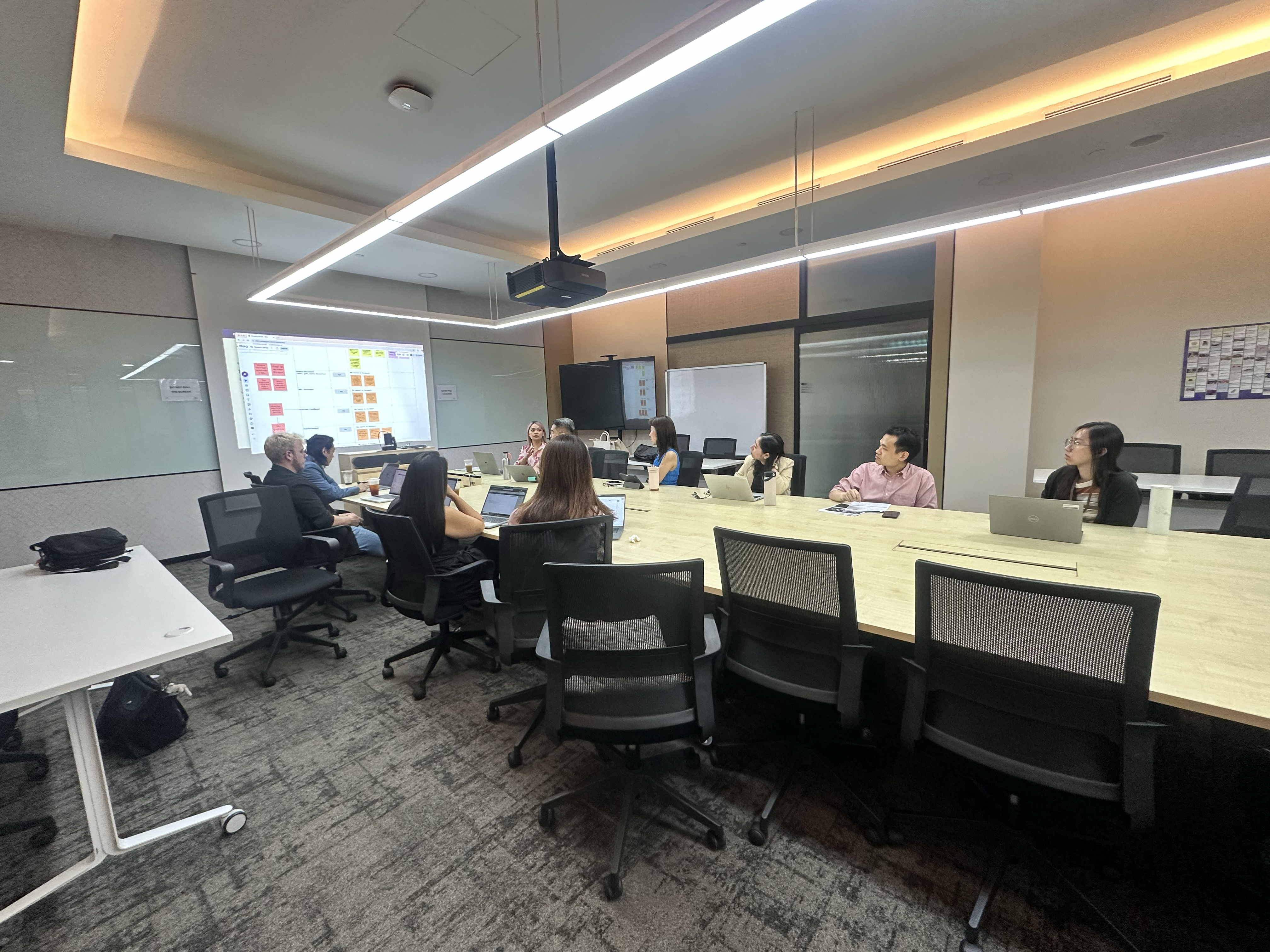
Stakeholder alignment workshop — reviewing synthesis across the five health domains
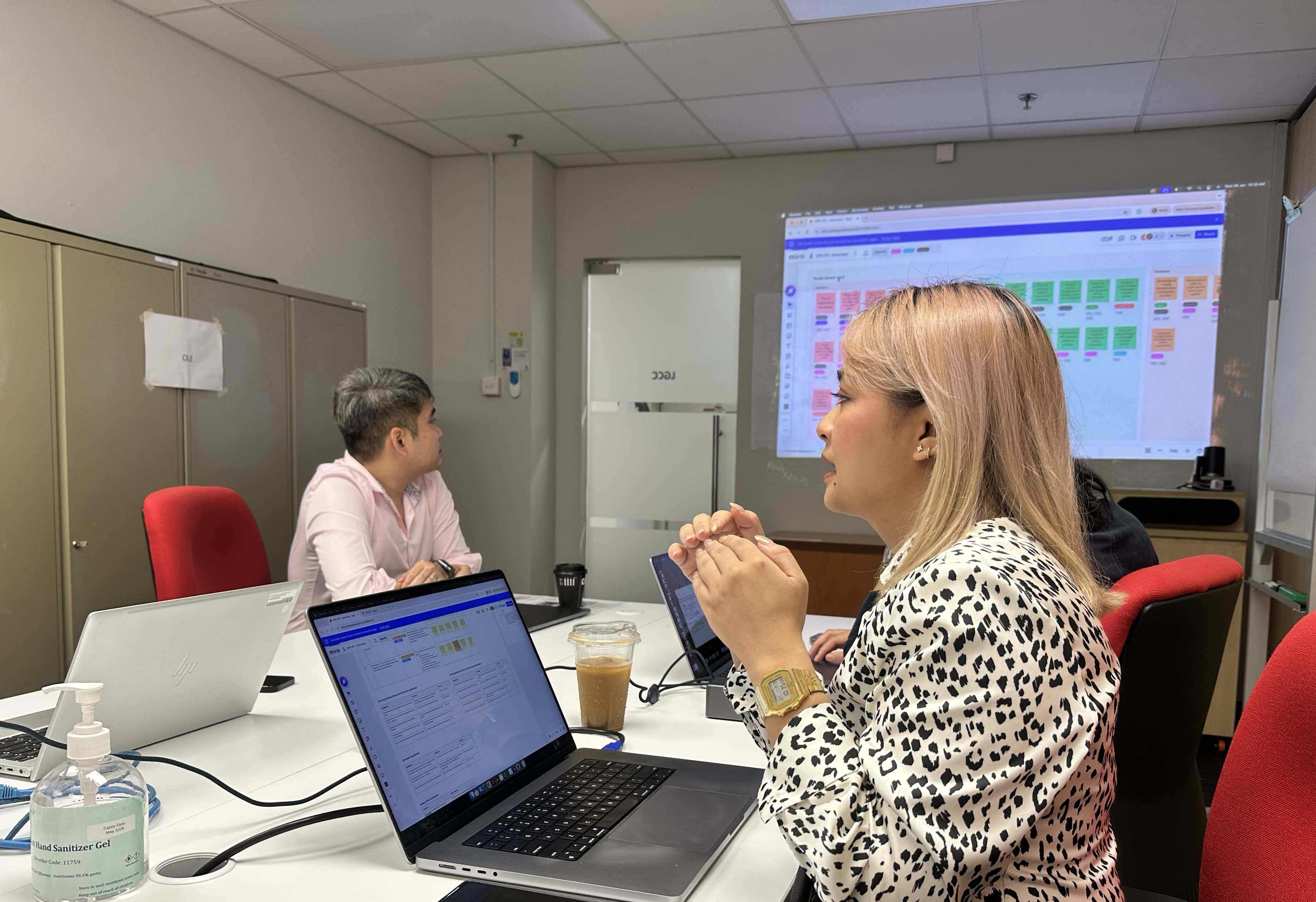
Rolling synthesis session — adjusting hypotheses as patterns emerged from interviews
Going in, the assumption was that youth are choosing to be unhealthy. The interviews showed the opposite. Youth know what healthy looks like and most want it. But three things keep getting in the way: (1) they know what to do but no one taught them how to do it alone, (2) structured routines fade while choices multiply, and (3) parents step back before youth are ready — creating distance instead of independence. This reframing — from "youth are making bad choices" to "the system around them is changing faster than their skills" — shaped every design decision that followed.
The agency's initial ask was 13–18. I pushed it to 13–16. With 12 youth interviews and four months, a wider range would have averaged out the mechanism we were trying to see. The trade-off was coverage; the gain was a defensible causal frame for why the drift happens when it does.
Three transition zones where habits break
The drift isn't random. It maps to three specific transitions where life changes and parents start stepping back. I also mapped how each Well performs across these transitions and built swimlane diagrams showing the full timeline.
P6 → Sec 1
"If this stage broken then very hard to counter in the future." — Parent
Sec 2 → Sec 3
Sec 4 → JC / IHL
"When I entered Sec 1, everything changed. New school, new friends, new timing. I had to figure everything out myself."
"In primary school, everything was structured. Dinner at 7, homework by 8, bed by 9:30. The routine held. Then secondary school started..."
The 2×2: where youth actually sit
I built a 2×2 matrix to organise what discovery and co-creation were telling us. It classifies where youth actually sit — not where adults assume they are.
Structured but Resistant
Youth follow rules to avoid trouble, not because they agree. They behave when forced but revert when structure lifts.
→ Help youth buy into the routine, not just follow it.
Supported & Functioning
Habits seem formed, but they're held up by people around them, not by the youth themselves.
→ Help youth take over before the support disappears.
The Drift
Most youth spend after-school time with friends and little guidance. They know what's healthy, but the easier choice still wins.
→ Help youth build strategies for when easy beats healthy.
Self-Managing ★
Youth do healthy things without someone making them. Own routines, strategies, and reasons. The north star.
→ Keep it going. Reinforce and celebrate.
The Vicious Cycle (current state)
The Ideal Cycle (where we're designing toward)
Two windows
In primary school, adults structured the whole day. In secondary, two large windows open where unhealthy choices happen without any adult awareness or support.
Morning
School
After School
Evening
Night
Three rules for anything we design: (1) It must work when parents can't see — the gap is where unhealthy choices happen. (2) Peers will shape choices in that gap, so we work with peer dynamics, not against them. (3) Replace, don't restrict — removing something without a better substitute means youth will find a workaround. Every concept we built followed these three rules.
Strategic frame
Research shaped three connected pieces: the question we're solving, the destination we're designing toward, and the guardrails that keep us honest.
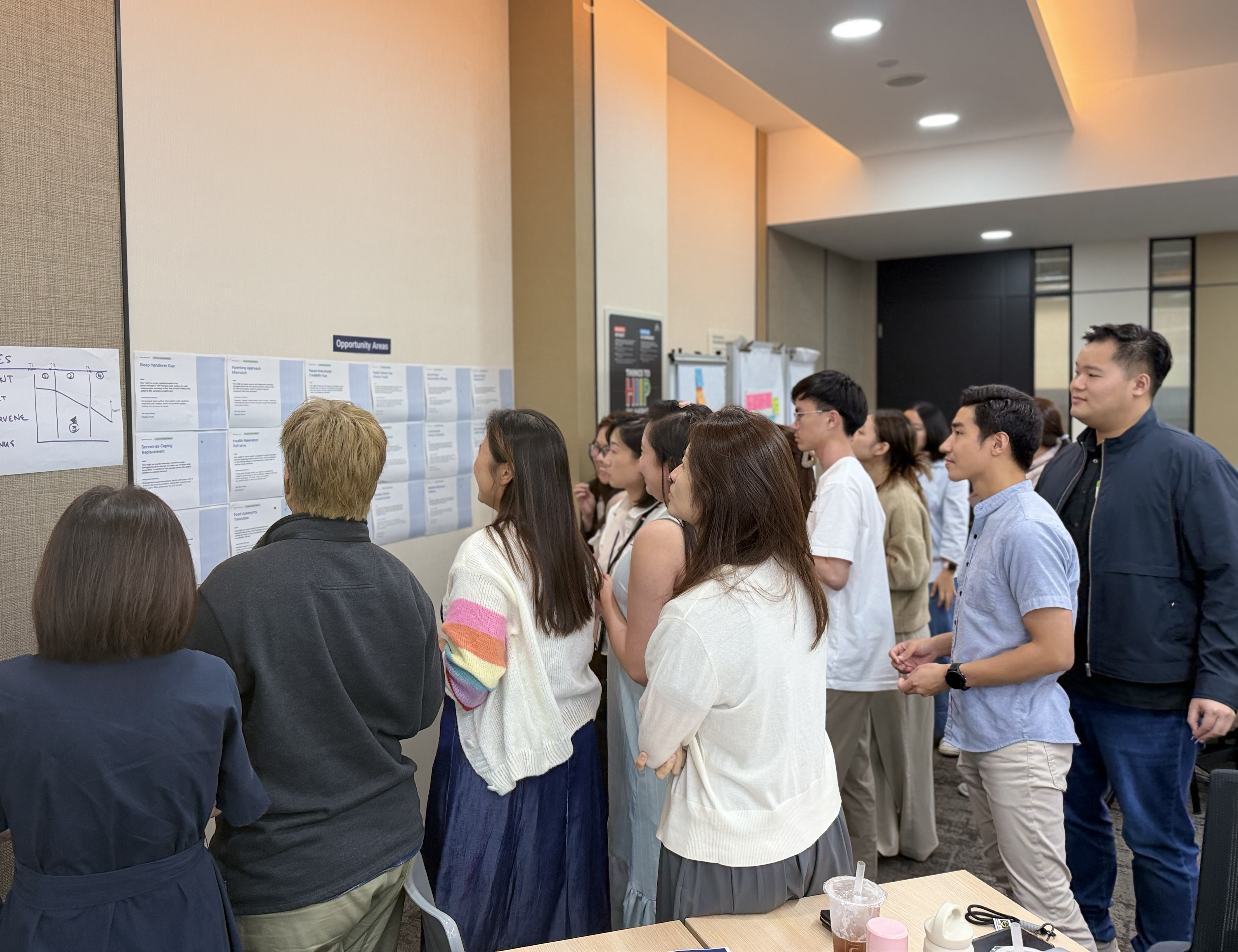
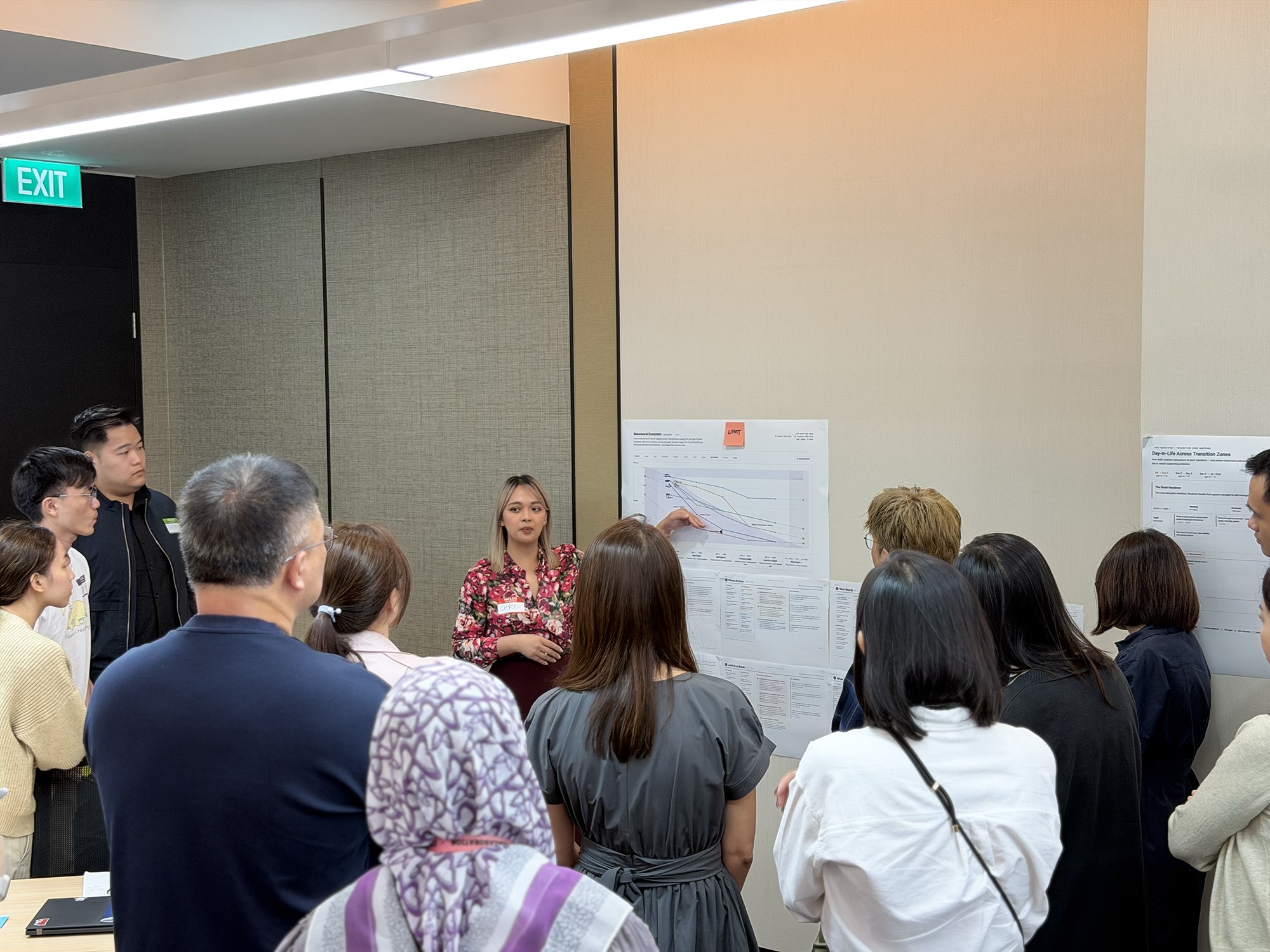
Gallery walk — participants reviewing research findings before the define session
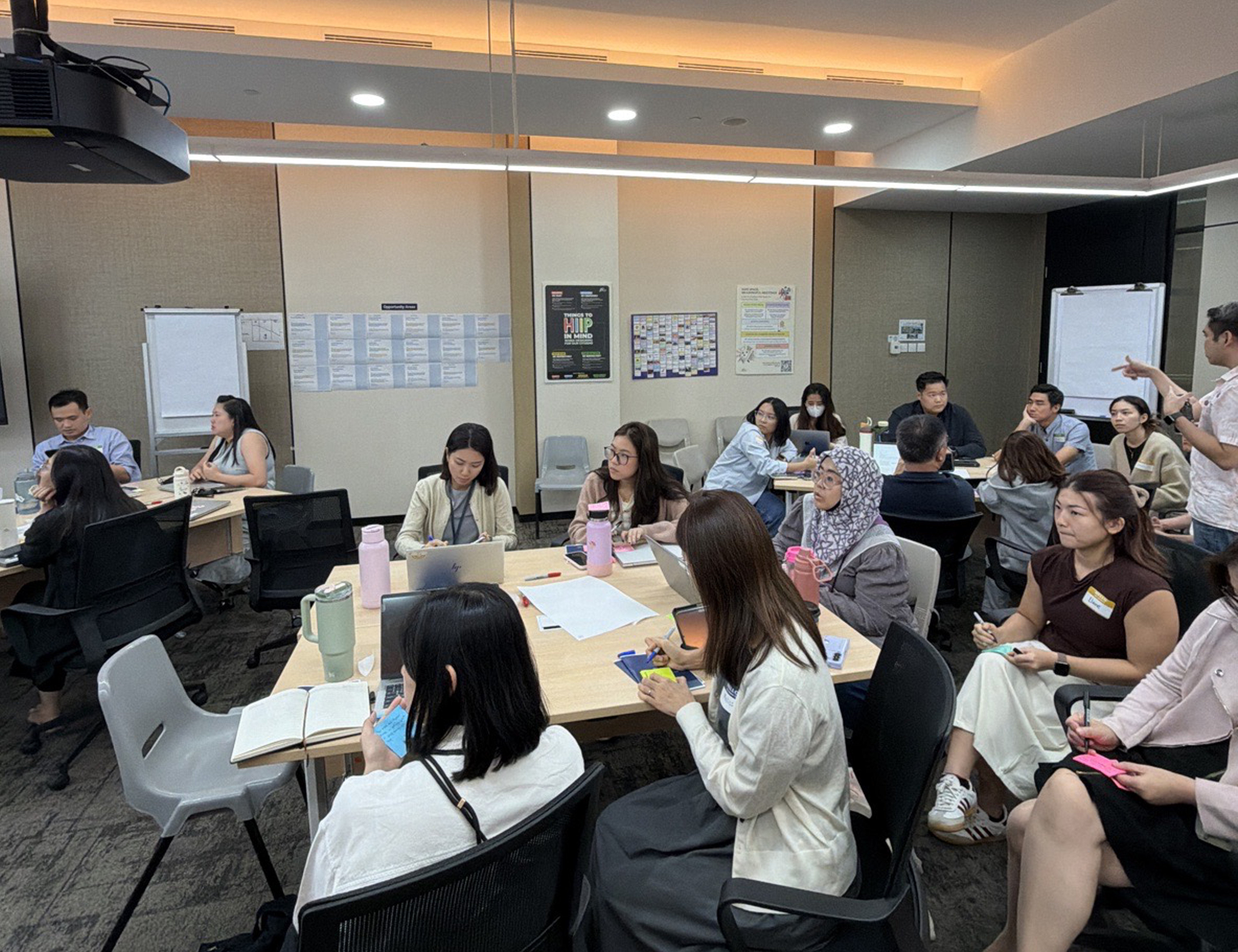
Define workshop — cross-functional groups working through opportunity areas
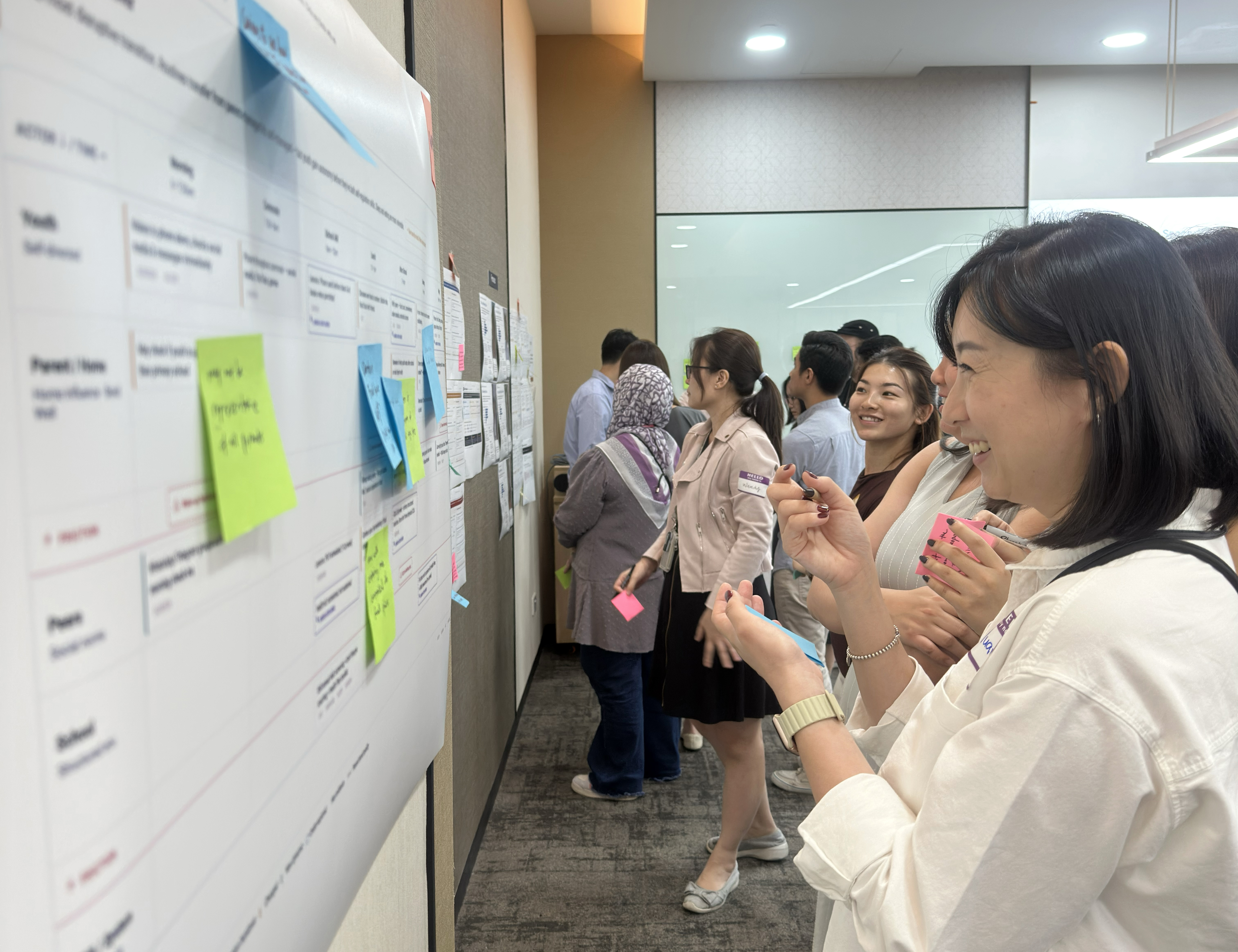
Participants adding to the research wall — mapping connections across health domains
Close-up — reacting to mapped findings and voting on priority opportunity areas
The HMW
"How might we motivate youth (aged 13–16) and their key supporters to build their confidence to start and sustain healthy habits across the 6 Wells, so that healthier choices become natural, even as routines change and independence grows?"
Empowered Transitions
Support at the moments where habits drift — P6 to Sec 1, Sec 2 to Sec 3.
Shared Rhythm
Turn "windows" into shared routines that both sides help shape.
Confidence Loop
Small wins grow trust. Trust gives freedom. Freedom builds habits that stick.
Design principles
Autonomy with guardrails
Design for shared structure, not control. Youth decide how things are done and parents work together with them.
Replace, don't restrict
Never restrict behaviour without introducing alternatives. Screens and fast food meet emotional and social needs. Remove them without alternatives and youth will find workarounds.
Make it fit the day they already have
If it doesn't slot into the after-school hangout, the bedtime window, or the dinner table, it won't get used. Design for real schedules, not ideal ones.
From 25+ ideas to 3 concepts
I ran co-creation workshops with 6 youth and 6 parents. Using the opportunity areas as prompts, I presented scenarios and let participants ideate what would help them in those moments. Two clear takeaways emerged:
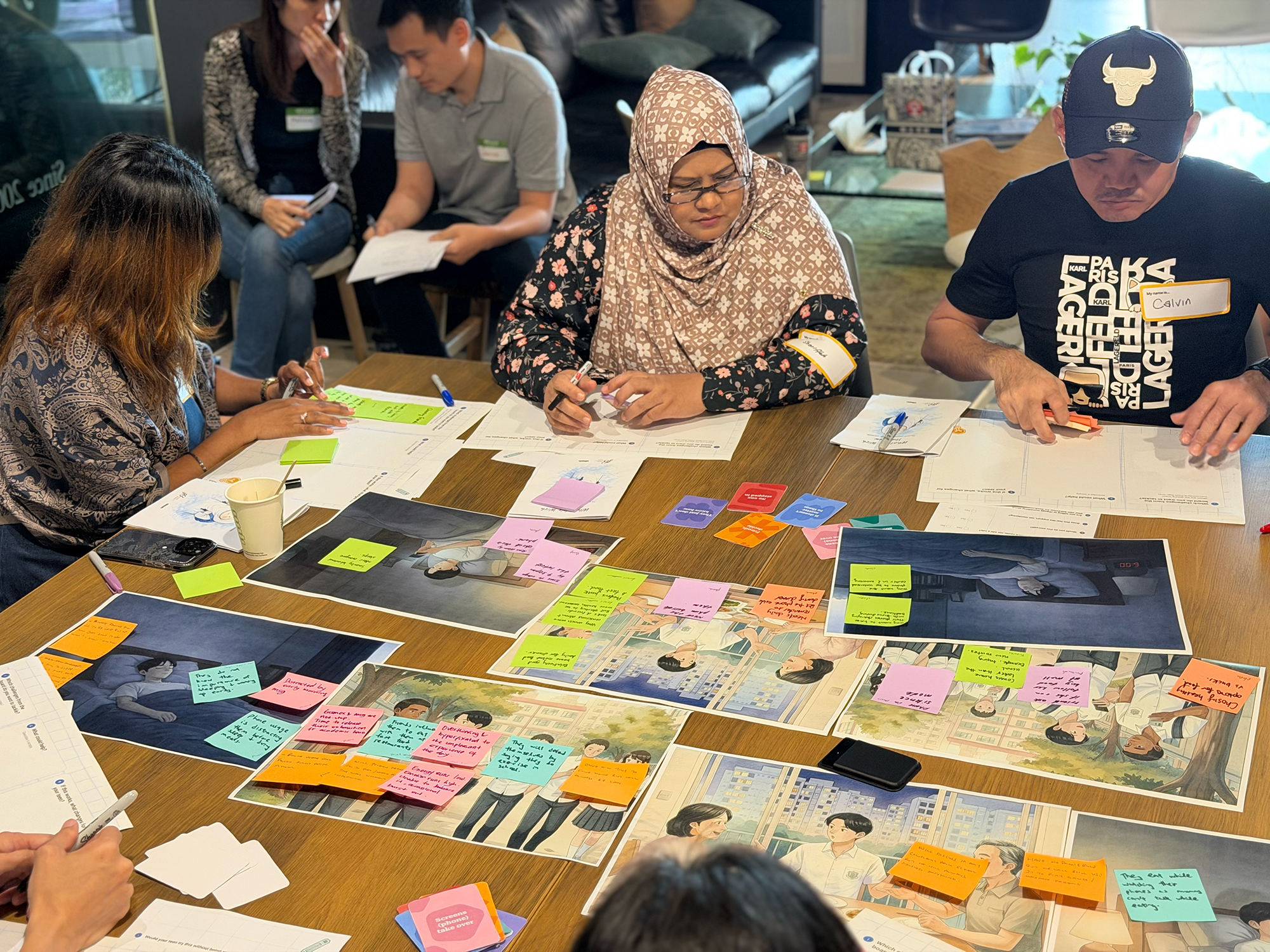
Parent co-creation session — generating ideas from scenario prompts grounded in real daily moments
Takeaway 1 — Parents
Parents came in with real self-awareness. But their strategies were built for primary school and haven't evolved. "I need to change myself too." They're not the problem — they just need tools that match where their child is now.
Takeaway 2 — Youth
Youth already know what's healthy. What they need is the how. When asked to design solutions, every idea changed something around them (the room, the routine) — not something inside them. Not one idea was "try harder."
Co-creation made one thing clear: families aren't in the same place. Some parents were ready to change tomorrow; others didn't see the problem. I anchored the project in the Transtheoretical Model (TTM) — staging families by readiness, not demographics. This shaped which concepts targeted which families: Bedtime Wind-Down for families already in preparation, Hook U Up for youth in contemplation who need a peer push, WOU for families stuck in precontemplation where the conversation hasn't started yet.
I took the 25+ ideas from co-creation and ran each through four filters: North Star (does this move youth toward natural healthy choices?), Design Principles (shared structure? replace not restrict? fits the real day?), Design Constraints (no standalone apps, must use the agency's existing channels, usable at home), and DVF Scoring (desirability, viability, feasibility). Only concepts that passed all four made it through.
The three concepts
No single concept covers all 6 Wells. Each targets specific wells and cascades into others. Together, they form a system that answers the HMW.
Bedtime Wind-Down
Why physical: A phone in the bedroom is the problem. Solving sleep with an app puts the trigger right back in their hands.
Hook U Up
Why physical: After-school time is already dominated by screens. A physical card deck displaces screen time rather than adding to it.
WOU (We Open Up)
Why physical: The whole point is face-to-face. A digital version removes eye contact, the table, and the shared moment.
↓ = cascade effect — improving one well pulls this one along
Validation findings
Tested all three prototypes with 24 participants (12 youth, 12 parents) through 60-minute moderated sessions.
Go to pilot Bedtime Wind-Down
The persistent physical cue beside the bed was the strongest signal — always visible, no willpower needed. An undesigned feature emerged as the most powerful: feelings magnets let youth signal emotional states without starting a conversation. The risk: the parent column was read as surveillance, not mutual commitment, and weekly reviews were universally flagged as a chore with predicted drop-off within 1–2 weeks.
Go to pilot Hook U Up
Highest desirability — two youth asked to buy it unprompted mid-session. Identity-first framing (Glow Up, Recharge, Energy Era) made health behaviour feel aspirational, not instructional. Peer accountability clicked instantly — youth compared it to Snapchat streaks without being told. The QR proof mechanic was completely blocked by the 2026 school phone ban, privacy concerns, and too many steps. "Bulk Up" label alienated female participants.
Needs physical testing WOU (We Open Up)
Most polarised — ratings split by family communication quality, not age. The swap mechanic produced genuine engagement and youth-led questioning was an unexpected strength (most parent-youth conversations only go one direction). But mechanic comprehension failed in online testing, questions were too deep for low-trust families, and there's no natural trigger to pick it up — unlike the board (visible) or cards (friend texts), this sits in a drawer.
After validation testing, I assessed each concept through three behavioural lenses. B=MAP (Behaviour = Motivation × Ability × Prompt) — to diagnose why certain mechanics failed: Hook U Up's QR proof had high friction (low ability) despite strong motivation; Bedtime Wind-Down's board was a persistent prompt that lowered the ability threshold. EAST (Easy, Attractive, Social, Timely) — to score each concept against behavioural design heuristics: Hook U Up scored highest on Social and Attractive; WOU scored lowest on Timely (no natural trigger). Kano model — to classify which features were baseline expectations vs. delighters: the feelings magnets and the swap mechanic were unexpected delighters that drove the strongest emotional responses, while the weekly review was a dissatisfier across the board.
Round 1 settled which behavioural mechanics worked. Round 2 — with 12 additional participants — asked a harder question: can these mechanics survive national scale through the agency's existing channels?
The convergence: from 3 physical prototypes to 2 ecosystem-native concepts
The testing protocol didn't need more participants — it needed sharper questions. I redesigned Round 2 to stress-test each concept against national-scale distribution, not user delight. That's what made the convergence undeniable: the artifacts tested well; the delivery path didn't.
Round 2 surfaced a pattern the team couldn't unsee. The behavioural mechanics worked. The artifacts didn't scale. A card deck in every household, a bedtime board for every bedroom — each had a distribution, maintenance, and replacement problem the agency couldn't solve at national scale. The answer wasn't to soften the research. It was to port the mechanics into channels the agency already owns.
I initially conceived Parent for Parent as a community-based peer-matching model: parent pairs, facilitator-led sessions, conversation guides. In Phase 4, when we mapped platform distribution, the model broke — the agency couldn't run peer-matching at national scale through PfW. I called it, reset the brief, and PfP became a content-module design inside PfW instead. The wrong framing cost three days. Naming it saved the concept. At senior levels, the miss you catch early is cheaper than the one you defend.
The three drift barriers map directly onto three shifts we had to design for: Knowing → Not Doing is a Knowledge shift; Structure → Gap is a Behaviour shift; Guidance → Friction is an Attitude shift. Both concepts — Wellbits 3.0 and Parent for Parent — were built to produce all three shifts together, not in isolation.
Two concepts, both within the agency's existing channels
National scale isn't built — it's inherited. Both concepts live inside platforms the agency already runs, so the distribution, governance, and trust problems are already solved.
Wellbits 3.0
- For
- Youth 13–16
- Mechanic
- Daily Character Check-In. Five character archetypes, thirty challenges calibrated to the after-school and bedtime windows.
- KAB target
- Attitude + Behaviour — autonomy, peer-positive framing, replace-don't-restrict.
- Why H365
- Scale is inherited, not built. Youth already touch H365 for tracking.
Parent for Parent (PfP)
- For
- Parents of youth 13–16
- Mechanic
- Structured content modules on the specific transitions where parents drift from supervising to reminding — written by parents who've lived it, not experts lecturing them.
- KAB target
- Knowledge + Attitude — relatable framing, confidence that the hard conversations are normal.
- Why PfW
- Parents already look to PfW for sanctioned guidance; it solves the trust problem.
Building the DVF Pilot Readiness framework
A pilot-ready verdict isn't a yes/no. It's a structured claim about what's been proven, what's assumed, and what the pilot itself still has to answer. The agency's governance process required evidence at three levels — does it work for users, does it work for the institution, does it work for the build — so that's the frame I designed the criteria around.
per criterion
Desirability (5 criteria) — "Does it work for users?" Drawn from validation testing evidence and co-creation patterns. Criteria cover behavioural fit, motivational alignment, and evidence of voluntary uptake in prototype testing.
Viability (5 criteria) — "Does it work for the institution?" Drawn from the agency's strategic priorities, measurement expectations, and programme sustainability constraints. Criteria cover policy alignment, measurability, and long-run cost-per-user at national scale.
Feasibility (5 criteria) — "Does it work for the build?" Drawn from H365 and PfW platform realities, vendor capacity, and time-to-pilot. Criteria cover technical lift, dependency risk, and delivery confidence.
Thresholds were calibrated with the PM against the agency's internal pilot-gate norms. Amber (pilot-ready with conditions) means specific gaps flagged for the pilot to resolve, not avoid. Both concepts scored into the pilot-ready range — each with its own conditions. The framework itself is reusable: the agency's team can re-score future concepts against the same criteria.
From today to national
Both concepts land inside the agency's existing platforms, so national rollout isn't a separate programme — it's a feature release.
One study, three parallel workstreams, 4–6 months
Three sequential phases would take 18 months. The agency doesn't have 18 months. The recommendation is one integrated study with three parallel workstreams — each owning a different question the programme has to answer before national launch.
RCT with embedded diary
A randomised controlled trial for each concept against a control arm, with embedded diary studies capturing qualitative evidence of behaviour change inside the drift windows.
Behavioural science advisory panel
A standing panel reviewing methodology and findings to give the agency internal defensibility when scaling.
Implementation readiness
Platform readiness audit, content pipeline build, and governance workflow so the day the evidence lands, national rollout is a configuration change, not a new programme.
Running them in parallel cuts 12 months off the path and — more importantly — means the programme can act on the evidence the moment it arrives.
What this project surfaced but didn't solve
A four-month HCD engagement can answer a bounded question well, but it will surface many more. I mapped the 26 underexplored areas this project surfaced into a three-tier strategic assessment — so the agency's next wave of work can pick them up with the context already structured.
Quick wins
Areas with existing evidence and a clear lever. Ready to act on without new research.
Example: formal sleep education in school curriculum.
Instruments & workstreams
Areas that need structured measurement or targeted qualitative work before the agency can commit to an intervention.
Example: the parent–youth conversation repertoire during Sec 2–3.
Longer-term systemic
Areas requiring policy coordination, cross-agency alignment, or multi-year horizons.
Example: the handover architecture between primary and secondary school wellness programmes.
Five of the 26 areas consolidate into strategic opportunity areas the agency can fund as their own next projects. The full matrix is available on request.
What I learned
What shifted how I think about designing for behaviour change — and what I'd carry into the next project.
Trust is a precondition, not a feature
The same product — identical design — was called a "communication lifeline" by one parent and "an invasion of privacy" by a youth. You can't design trust into a product. You can only design for families who already have the gap they're trying to fill. This taught me to segment by readiness, not demographics.
Never take something away without offering something better
The most consistent finding across the entire research: bans trigger sneakier behaviour. "Once take back, I will go back to my sneakier behaviour!" — Amanda, 15. Every attempt to remove phones or ban fast food met with workarounds. What worked was offering something that met the same need through a different channel.
The best features are the ones you didn't design
The feelings magnets on the Bedtime board weren't designed as a communication tool. But they became the strongest emotional channel — youth could signal how they felt without starting a conversation. The youth-led questioning in WOU was the same: not designed, but emerged as the most powerful feature. I learned to design for emergence, not just function.
Knowing when rigour is defence vs. decision-making
In Phase 2 my instinct was to deepen the research frame before narrowing. The PM pushed back — narrow first, thicken where it actually matters. She was right. I've since calibrated the difference between "what I want to be sure of" and "what the decision actually requires." On this project it saved two weeks and sharpened the final concepts. It's the kind of call I now make earlier.
Collaboration and stakeholder engagement
Structured decisions, not presentations
I ran 4 gate reviews with the agency. Each gate was built around a decision point, not a status update — and every recommendation followed causal logic back to the data. If we said "this concept should go to pilot," we could trace it to a specific finding, a specific participant quote, a specific behavioural pattern. Nothing was asserted — everything was evidenced. This meant stakeholders weren't reacting to opinions; they were evaluating chains of reasoning they could interrogate and trust.
Shared frameworks as alignment tools
The drift, the 2×2, the two windows — I built these as thinking tools for the team, not just research outputs. They gave everyone a shared vocabulary for evaluating ideas and explaining decisions to stakeholders.
Feedback loops, not handoffs
Every phase transition included a built-in feedback loop. Stakeholder input shaped the next phase before it started, not after. This meant no phase ran on assumptions from the one before.
Working with participants, not on them
Co-creation wasn't a checkbox. I designed scenario prompts around real moments in their day, then let youth and parents generate the ideas. Every concept traces back to something a participant said or built — I shaped and filtered, but the ideas came from them.
The four gates — what was decided
Where this landed
We started with a brief about declining health metrics. We ended with two pilot-ready concepts the agency can launch through platforms it already runs, a Pilot Readiness framework its team can reuse on future concepts, a 7–8 month roadmap to national scale, a proposed integrated validation study, and 26 underexplored areas mapped for the next wave of work. The most important reframe of the project: youth aren't choosing to be unhealthy — the structures holding their habits just disappear, and nobody taught them what to do when that happens. The concepts that made it through are the ones that fill that gap at national scale.